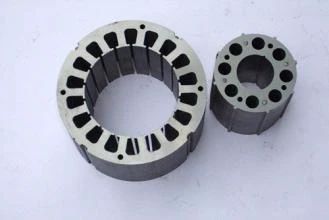
The core of a common transformer is generally made of silicon steel sheets. Silicon steel is a type of steel alloyed with silicon (also known as silicium), with a silicon content ranging from 0.8% to 4.8%. The reason silicon steel is used for the transformer core is that it is a magnetic material with very strong magnetic permeability, which can generate a higher magnetic flux density in a coil carrying an electric current, thereby reducing the size of the transformer.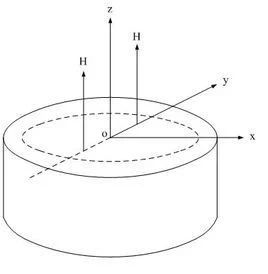
As we know, transformers always operate under alternating current (AC) conditions, and power losses occur not only in the resistance of the coil but also in the iron core due to alternating current magnetization. The power loss in the core is commonly referred to as "iron loss," which is caused by two factors: "hysteresis loss" and "eddy current loss."
Hysteresis loss is the iron loss generated during the magnetization process of the core due to the presence of hysteresis. The magnitude of this loss is proportional to the area enclosed by the material's hysteresis loop. Silicon steel has a narrow hysteresis loop, so using it for the transformer core results in lower hysteresis losses, significantly reducing heating.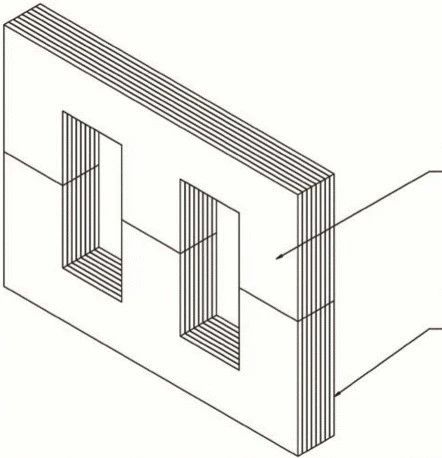
Given the advantages of silicon steel mentioned above, why isn't a solid piece of silicon steel used as the core, but instead processed into thin sheets? This is because laminated cores can reduce another type of iron loss—“eddy current loss.”
When the transformer operates, the coil carries alternating current, which produces an alternating magnetic flux. This changing magnetic flux induces currents in the core. These induced currents circulate in planes perpendicular to the direction of the magnetic flux and are called eddy currents.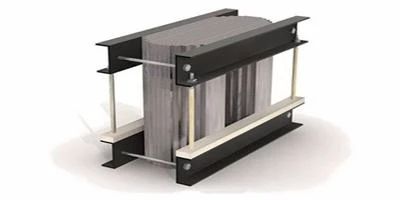
Eddy current losses also cause the core to heat up. To minimize eddy current losses, the transformer core is made of insulated silicon steel sheets stacked together. This forces the eddy currents to flow through narrow, elongated loops with smaller cross-sectional areas, increasing the resistance in the eddy current path. Additionally, the silicon in the steel increases the material's resistivity, further reducing eddy currents.
For transformer cores, cold-rolled silicon steel sheets with a thickness of 0.35mm are typically used. These sheets are cut to the required dimensions and then stacked in a "日" or "口" shape. Theoretically, the thinner the silicon steel sheet and the narrower the laminations, the better the reduction in eddy current losses. This not only reduces eddy current losses and lowers temperature rise but also saves on the amount of silicon steel used.
However, in practical manufacturing, considerations go beyond just these benefits. Making the core in such a way would significantly increase production time and reduce the effective cross-sectional area of the core. Therefore, when making transformer cores from silicon steel sheets, specific circumstances must be considered, balancing pros and cons to select the optimal dimensions.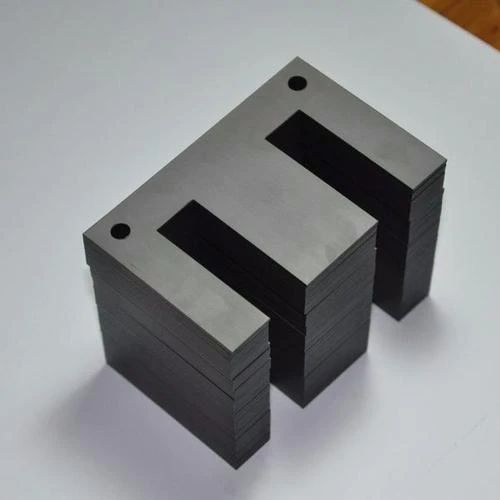
Transformers are made based on the principle of electromagnetic induction. On a closed iron core column, there are two windings: the primary winding and the secondary winding. When the primary winding is connected to an AC voltage source, alternating current flows through it, establishing a magnetomotive force. Under the influence of this force, alternating main magnetic flux is produced in the core.
As for why it can step up or step down voltage, this requires an explanation using Lenz's Law. The magnetic flux induced by the current always opposes the change in the original magnetic flux. When the original magnetic flux increases, the induced magnetic flux generated by the secondary winding is opposite to the original magnetic flux, resulting in a lower-level alternating voltage in the secondary winding. Hence, the core serves as the magnetic circuit part of the transformer.
Silicon Steel Sheets: Electrical silicon steel sheets, commonly known as silicon steel sheets or silicium steel sheets, contain silicon at levels of 0.8%-4.8%. They are produced via hot or cold rolling and typically have a thickness of less than 1mm, hence the term "thin sheets." Silicon steel sheets belong to the broader category of sheet materials but form their own branch due to their specialized use. Electrical silicon steel sheets boast excellent electromagnetic properties and are indispensable magnetic materials in the power, telecommunications, and instrumentation industries.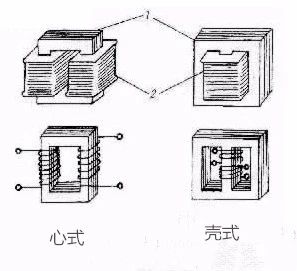
(1) Classification of Silicon Steel Sheets: A. Based on silicon content, silicon steel sheets can be divided into low-silicon and high-silicon types. Low-silicon sheets contain less than 2.8% silicon, possess certain mechanical strength, and are mainly used for motor manufacturing, often referred to as motor silicon steel sheets. High-silicon sheets contain 2.8%-4.8% silicon, exhibit excellent magnetic properties but are more brittle, and are primarily used for transformer cores, commonly called transformer silicon steel sheets. In practice, there is no strict boundary between the two, and high-silicon sheets are often used to manufacture large motors.
B. According to the production process, they can be classified as hot-rolled or cold-rolled. Cold-rolled sheets can further be categorized as grain-oriented or non-grain-oriented. Cold-rolled sheets are uniform in thickness, have good surface quality, and exhibit higher magnetic properties. As a result, with industrial development, cold-rolled sheets are gradually replacing hot-rolled ones (China has explicitly required phasing out the use of hot-rolled silicon steel sheets, also known as "cold replacing hot").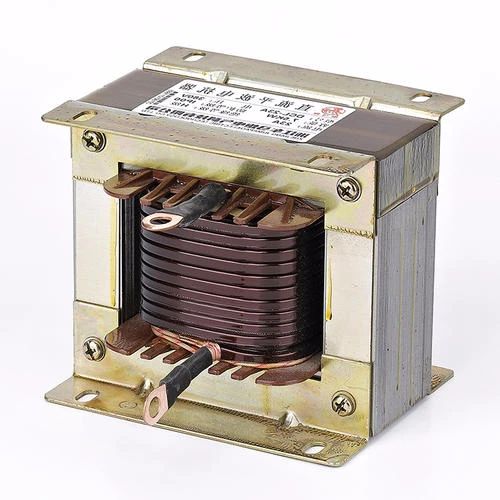
(2) Performance Indicators of Silicon Steel Sheets: A. Low core loss. Core loss is the most crucial quality indicator, and countries worldwide classify grades based on core loss values. Lower core loss corresponds to a higher grade and better quality. B. High magnetic induction. Silicon steel sheets that achieve higher magnetic induction under the same magnetic field allow for smaller and lighter transformer or motor cores, saving materials like silicon steel, copper wire, and insulation. C. High stacking factor. Smooth, flat surfaces and uniform thickness improve the stacking factor of silicon steel sheets. D. Good punching performance. This is especially important for manufacturing small or micro-motor cores. E. Good adhesion and weldability of the insulating film on the surface. F. Magnetic aging. G. Silicon steel sheets must undergo annealing and pickling before delivery.
(I) Hot-Rolled Electrical Silicon Steel Sheets (GB5212-85): Hot-rolled electrical silicon steel sheets are made from low-carbon, low-loss silicon-iron soft magnetic alloys and rolled to a thickness of less than 1mm. Also known as hot-rolled silicon steel sheets, they are classified into low-silicon (Si ≤ 2.8%) and high-silicon (Si ≤ 4.8%) types based on silicon content.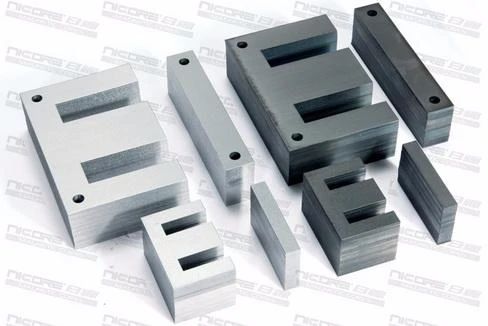
(II) Cold-Rolled Electrical Silicon Steel Sheets (GB2521-88): Made from electrical silicon steel containing 0.8%-4.8% silicon and cold-rolled. Cold-rolled silicon steel sheets are divided into grain-oriented and non-grain-oriented types. Cold-rolled electrical steel strips feature smooth surfaces, uniform thickness, high stacking factors, and excellent punching performance. Compared to hot-rolled strips, they offer higher magnetic induction and lower core losses. Using cold-rolled strips instead of hot-rolled ones for motor or transformer manufacturing can reduce weight and volume by 0%-25%.
If grain-oriented cold-rolled strips are used, the performance is even better. Replacing hot-rolled strips or lower-grade cold-rolled strips with grain-oriented ones can reduce transformer energy consumption by 45%-50%, ensuring more reliable transformer operation. Non-grain-oriented cold-rolled strips are typically used for motors or welding transformers, while grain-oriented ones are used for power transformers, pulse transformers, and magnetic amplifiers. Sheet specifications: thicknesses of 0.35mm, 0.50mm, and 0.65mm; widths of 800-1000mm; lengths up to 2.0m.
(III) Home Appliance Hot-Rolled Silicon Steel Sheets (GBH46002-90): Home appliance hot-rolled silicon steel sheets are designated with the prefix JDR (J for home, D for electrical, R for hot-rolled). The number following JDR represents the core loss value multiplied by 100, and the number after the hyphen represents the sheet thickness (in mm) multiplied by 100. These sheets have slightly lower electromagnetic performance requirements, with a minimum core loss value (P15/50) of 5.40W/kg. They are typically delivered without additional washing and are used in various household appliances, including fans, washing machines, vacuum cleaners, and range hoods.